

- cross-posted to:
- world@lemmy.world
- cross-posted to:
- world@lemmy.world
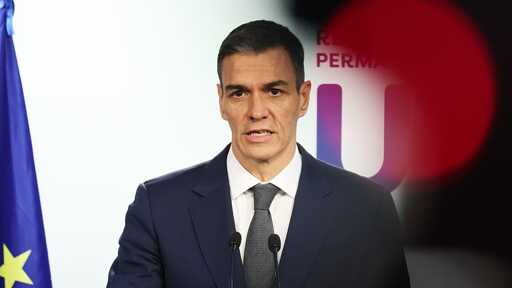
Spain’s Prime Minister Pedro Sánchez openly condemned the US and Israeli strikes on Saturday, warning that they could heighten regional tensions and “contribute to a more uncertain and hostile international order.”
This is conflation and false equivalence. You are bundling together Hezbollah’s actions, Iranian drones in Ukraine, and Iran’s internal repression as if they’re all the same threat. Each issue is distinct and requires its own response. Hezbollah operates semi-independently, Iran’s drone exports are part of a separate conflict, and domestic repression is a human rights issue. You and your propaganda are trying your best to create a misleading picture of a single, unified enemy, which can justify broad military action rather than targeted, diplomatic solutions. The bigger risk is that this kind of framing escalates tensions instead of resolving them. Treating all these issues as one ignores the complexity of each and can lead to overreach or unintended consequences. A more effective approach is to address each problem on its own terms (through diplomacy, sanctions, or multilateral cooperation) rather than treating them as part of a monolithic threat. Then again, if republicans were ever interested in peace they wouldn’t have ripped the nuclear agreement with Iran. Which they did despite no evidence of a nuclear weapons program after it was halted.
You replied to my comment on the Spanish government with “dying for Israeli policy” when no European troops are involved in this so far and you accuse me of making false equivalences and conflation?
Are you now talking about US politics? That was not my point, at all. Again, from an European perspective there’s not reason to get too involved, including no reason to “slam the attack”, as this can very much serve our own interests and it’s in our best interest that the Iranian regimes falls to the ground.
No one is arguing that Europe should avoid involvement in the Middle East; the question is how Europe should engage. The notion that further antagonizing Iran or destabilizing the Middle East, especially through direct conflict, would somehow benefit European interests is not just deeply flawed; it is delusional.
The moral argument against Iran’s regime is beyond dispute. We can all agree that the regime is reprehensible, but we must also carefully assess the direct repercussions for European interests:
Economic Fallout: Europe’s energy security and trade routes depend on Middle Eastern stability. A major conflict would disrupt oil and gas supplies, send energy prices soaring, and fuel inflation at a time when European economies are already fragile. The 2022 energy crisis demonstrated just how vulnerable Europe is to regional instability. Iran’s control over the Strait of Hormuz means any escalation risks severing critical supply lines. If Europe becomes reliant on the US for regional stability, it effectively becomes a hostage to American policy.
Migration and Security: Instability in the Middle East has repeatedly triggered mass displacement and migration waves toward Europe. A collapsed Iranian regime or prolonged conflict would likely intensify this, straining European borders, resources, and political cohesion. The result would be a new migration crisis, further empowering far-right parties and undermining European institutions.
Terrorism and Radicalization: A destabilized Iran or a regional power vacuum could embolden extremist groups, increasing the risk of terrorism in Europe. For all its flaws, Iran’s current regime at least acts as a counterweight to groups like ISIS. Its collapse could unleash chaos that spills over into Europe through radicalized networks or direct attacks. European civilians would likely pay the price for this war and, in effect, for Israel’s foreign policy objectives.
Diplomatic Isolation: Europe’s global influence rests on its ability to act as a mediator and uphold international law. Openly advocating for regime change or conflict (without a clear plan for the aftermath) would alienate partners, erode Europe’s moral standing, and tie it to hardline US or Israeli policies that many Europeans oppose. It would also complicate negotiations on issues like nuclear proliferation or regional conflicts. Moreover, this war lacks legal justification. Spain’s position is perfectly understandable, especially when considering the broader context of US politics, which must be factored in, given that the US is driving the war effort.
Strategic Dependence: Europe is not the US; it lacks the military or economic leverage to unilaterally shape outcomes in the Middle East. Antagonizing Iran would force Europe to either blindly align with US-Israeli actions (losing autonomy) or face retaliation (cyberattacks, proxy conflicts, or economic pressure) without the means to respond effectively. This underscores Europe’s vulnerability in securing trade routes in the short term, before it can develop independent capabilities.
Long-Term Instability: Regime change rarely leads to stable, pro-Western democracies; more often, it creates failed states or hostile governments. A fragmented Iran could become a haven for warlords, extremists, or rival powers like Russia or China (none of which serve European interests). Even among Iranian supporters of liberal reforms, there is widespread contempt for the West. Europe gains nothing by being lumped in with the US and becoming a target for a new generation of Iranian terrorists.
Rising Oil Prices and Russian War Funding: Instability in the Middle East inevitably drives up global oil prices, which directly bolsters Russia’s war economy. Higher oil revenues enable Moscow to sustain and even expand its military mobilization, placing both Europe and Ukraine in an even more precarious strategic position.
In short, while the current Iranian regime is deeply problematic, the war unleashed by Trump and the Republican Party (and the potential collapse of Iran) would pose far greater risks to Europe than the status quo. The prudent course is de-escalation, diplomacy, and pushing for reform, not betting on chaos.
US politics are absolutely relevant here: The US is the driving force behind this escalation, and Europe cannot ignore this reality. Trump is desperate to bury the Epstein scandal and hopes a war and terrorism will distract from his economic policy failures. Leaks suggest that top Republican circles around Trump are hoping to provoke a crisis that could justify martial law and greater control over elections, or even their suspension. Meanwhile, Big Tech is aggressively lobbying Washington to take a stand against European regulation, as seen in the recent exchange between Musk and the Spanish government. The US is well aware of how damaging this war would be for Europe, and very likely is counting on it to fragment the EU and sow division.
And you think Spain, or any reasonable nation, should not condemn these attacks?