Then why hasn’t a better blockchain based currency gained any popularity? If they don’t have critical mass then your distinction is meaningless. It turns out there is just zero real world need for an untrusted distributed ledger. Databases and governments solve the problem much better.
Cryptocurrency development makes a whole bunch of arbitrary value-guided decisions during creation, all of these decisions have tradeoffs such that nobody has figured out a way to feature them all at the same time, or would they want to.
For example, bitcoin is fully auditable. Anyone with a copy of the bitcoin blockchain can review every single transaction in bitcoin’s history, and trace the flow of every last satoshi from it’s mining to today. This is because the developers of bitcoin place a high value on verifiable auditability and security. Conversely monero was developed for the purpose of being a completely untraceable, unauditable currency that still has a knowable supply. And ethereum was created in a manner that intentionally supported scripting, so that it could be used as a platform for novel applications and contracts. None of these primary features could be ported to either of the other two without breaking them completely, because of the deep programmatic implications of the requirements.
It’s not really a question of better or worse, but of use case. The fact of the matter is that the reason these three examples are the leading currencies for their use case is literally because nobody has yet been able to do a better job. And for bitcoin at least, at this point it’s security rests just as much in it’s wide adoption and interest as it’s design intent, so it’s unlikely that anyone ever will.
Questioning the technical virtues of an alternative product based on lack of critical mass adoption is pretty funny, when you consider we’re on the fediverse. I know that doesn’t defray your argument, but just an amusing observation.
I see why you might draw the comparison, but I actually don’t think the comparison is valid at all. Forums/communities can still be useful and fun with only a few people. Discord is also massively popular with a small community model, for a more successful example to compare with the fediverse. However a currency that nobody uses or accepts is entirely useless until mass adoption happens. That’s why they typically get mandated by force by governments.
You don’t need mass adoption to be useful, the more adopted a currency is the more useful it becomes but it’s not binary. Seychelles has a population of 130k, does that mean that the seychellois rupee is useless? Of course not, 130k people use it everyday.
~100 milion people use or at least own bitcoin, meaning they would probably be willing to pay or accept payment in it, that’s 1.3% of the world’s population, 1 in 80 people, that puts bitcoin between the Japanese yen and the British pound. ~260 milion people use crypto currencies in one way or another, over 3% of world’s population, 1 in 30 people, that’s just under the euro or the us dolar. And if you use 1 crypto you basically know how to use them all, just like €,$,£. If that’s not mass adoption I don’t know what is.
Most merchants who accept ₿ also accept other cryptos like ethereum, stable coins, litecoin, monero, tron, bitcoin cash… There are payment gateways that make it incredibly easy and automatically convert to your currency of choice, so there is no reason not to accept even the shittiest of shitcoins if it will be swapped before it even gets to you.
People bring up crypto because it is the only use of blockchain that isn’t worse than already established methods. And crypto is only “better” because it’s unregulated and allowed a bunch of scams to be pulled.
Uses of blockchain other than cryptocurrency that just came to my mind, some are already functioning or being introduced:
Decentralized, trustless, uncensorable domains that don’t require kyc to purchase.
Decentralized, trustless, uncensorable replacement for certificate authorities that can’t be hacked as easily as CAs can.
Decentralized, trustless, uncensorable server for small data like pgp signing keys, torrent magnet links, file hashes, static websites, code etc.
Decentralized, uncensorable, distributed way to store archival information or historical records like weather data, government document records, wikipedia edit history, book versions. Anything that shouldn’t change or is in danger of getting censored.
Automated financial markets open to the public through tokenization like stocks, bonds, commodities all settled on chain without 3rd parties.
Trustless on-chain contracts/smart contracts that will execute automatically or can be proven without a notary.
Decentralized, uncensorable, trustless identity system
If [other applications of the blockchain, which has now existed for an extremely long time] don’t have critical mass then your distinction is meaningless.
I’m not convinced there’s any internal use for blockchain. Internal implies under a specific umbrella, some overarching organisation, who can then be the central trusted server that makes blockchain unnecesary.
That said, non-public but open uses, such as tracking dealings between companies in markets with little trust and no single governments (the shipping example in your referenced comment) is indeed the thin slither of a plausible use-case.
Another limitation is that blockchain loses its benefits if anyone tries to design over the complexity of using it directly (using a ui that under the hood uses blockchain is no different to using a ui that talks to a central database, you’re trusting the central ui provider, you need to (at least be able to) build your own interface to realise the benefits of blockchain.
That means blockchain basically will never benefit individuals, it can’t. Sure, you could have multiple compatible uis shared around, but that’s no different security-wise to multiple central banks with an interoperable transfer system.
The only place blockchain has real benefits is when multiple large corporations/governments are interacting and don’t trust eachother/anyone.
See the link in my other replies for some examples of internal uses that still benefit from immutable, distributed ledgers.
Large organizations still have loss and risk from individual bad actors. Operating a central authority that validates every single transaction in a ledger, and validates ledger history and consistency, can be prohibitively complicated. A well designed blockchain implementation can resolve most of these issues.
A great example is a pharma/healthcare company that wants to manage medicine batch and expiration tracking, as well as distribution/patient assignment. With a traditional infrastructure every participant needs to phone home to a central authority. In a blockchain setup, peers can report ledger events one hop up and propagate it through the chain.
That’s a very simple example but I hope it gets my point across
Etherium and virtually the whole rest of the crypto scene that is “not bitcoin” has pretty soundly rejected the wasteful Bitcoin design. There was even a fork of Bitcoin that would have used the much more efficient proof-of-stake, but since that would be bad for everyone with a proof-of-work “mining” rig it didn’t take over.
It turns out there is just zero real world need for an untrusted distributed ledger
An “untrusted distributed ledger” is literally the backbone of modern software development. While you could plausibly split hairs and assert that git requires “trust”, I don’t think you’d wind up in a spot that both supports your assertion and a cognizable difference for anyone but mathematicians and security nerds. (And even if you did, the exact same sort of non-scam usages of blockchains are ones that operate like git, with the ledger used for something else.)
The most distinguishing feature is that it’s private by default, the sender, receiver and the amounts are cryptographically hidden from uninvolved parties. Other than that
Tiny fees - fees are only used to prevent spam, not to replace block rewards.
Tail emissions - every block rewards the miner with 0.6 XMR ensuring chain security, keeping the fees low and the inflation predictable and small - forever approaching 0 but never reaching it.
Variable block sizes - the block size grows and shrinks with the demand, allowing for more transactions when demand is high but still limiting spam.
RandomX mining algorithm - ASIC resistant mining algorithm best mined with the CPU ensures fair access to mining and prevents big minig firms from taking over the mining process.
Community and culture - the focus of most other cryptos is investing and speculation while monero’s focus is on being the best private, uncensored, p2p money. Because of this while other cryptos encourage their users to HODL their coins, monero users are encouraged to save and also spend their coins, treat them like digital cash rather than something who’s only purpose is to go up in price. In my opinion this culture leads to several things:
Business acceptance - many privacy centric services like VPN, VPS, e-sim, phone top up, gift card providers etc. accept monero. Usually any service that does, sees it at the top of the chart as the most used crypto, often more than all the other coins combined. Many open source projects accept it for donations as well, with similar findings.
Community built infrastructure - the monero community focuses on building the infrastructure around the idea of monero being digital cash. Things like xmrbazaar.com, a monero based e-bay/craigslist like market where you can buy/sell things for monero, kuno a monero based gofundme alternative for fundraisers, retoswap.com an instance of haveno, a decentralized, p2p monero exchange, monerica.com a repository of monero accepting business and other monero related things are designed with the idea of treating monero as money.
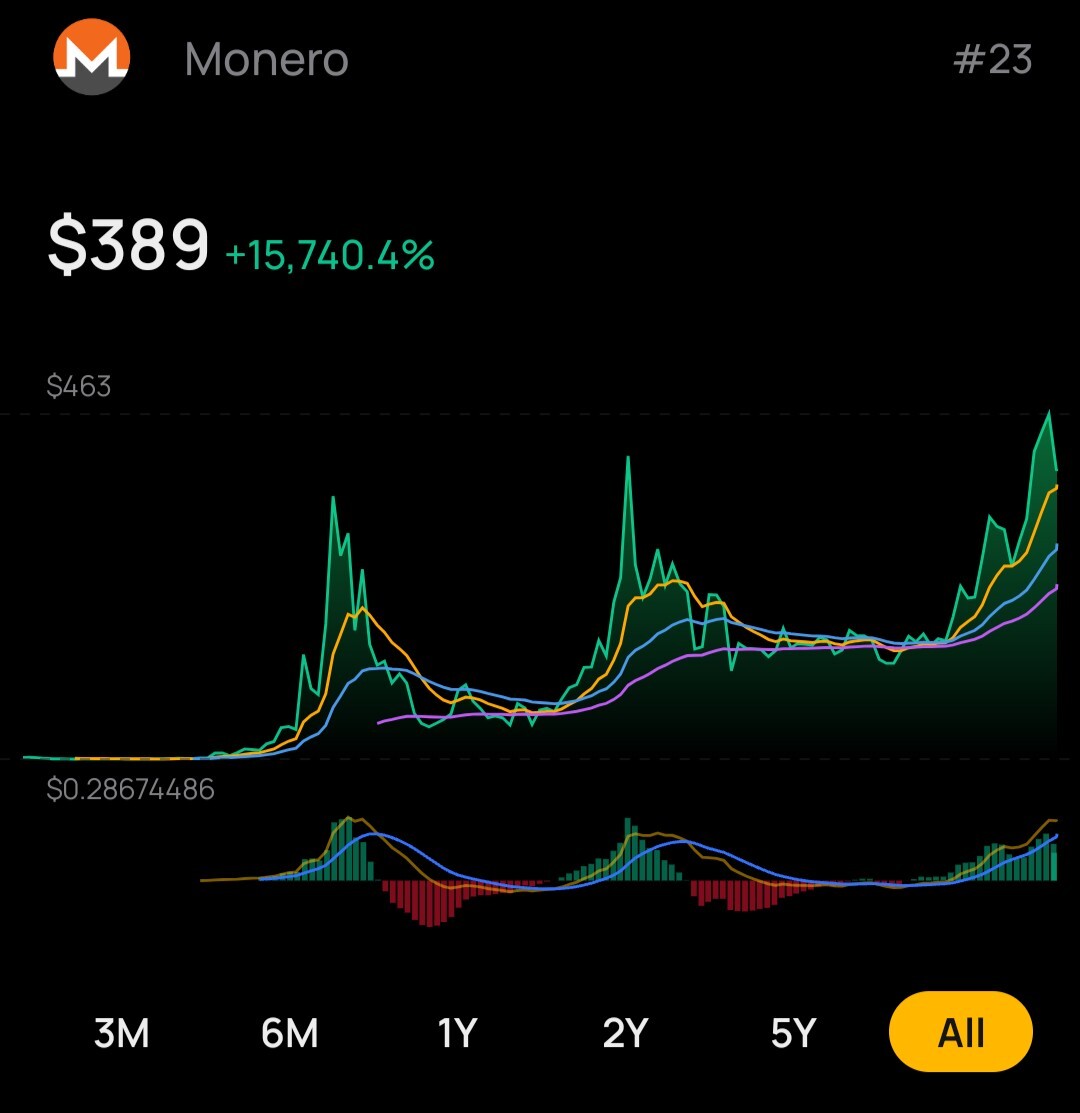
Price stability - because of the fact that monero is actually used for payments it’s price is established through adoption rather than speculation which makes it fairly stable in comparison to the rest of the crypto market, thanks to this you can safely spend and receive monero without worrying that a month from now it will loose 50% of it’s value. Of course, there are peaks and valleys often caused by the macro market movements like the recent few day pump to $800 and crash back to $400 but that’s an exception rather than the rule, for the most part (excluding stable coins) it’s one of the most stable cryptos out there with a slight long-term uptrend.


Then why hasn’t a better blockchain based currency gained any popularity? If they don’t have critical mass then your distinction is meaningless. It turns out there is just zero real world need for an untrusted distributed ledger. Databases and governments solve the problem much better.
Cryptocurrency development makes a whole bunch of arbitrary value-guided decisions during creation, all of these decisions have tradeoffs such that nobody has figured out a way to feature them all at the same time, or would they want to.
For example, bitcoin is fully auditable. Anyone with a copy of the bitcoin blockchain can review every single transaction in bitcoin’s history, and trace the flow of every last satoshi from it’s mining to today. This is because the developers of bitcoin place a high value on verifiable auditability and security. Conversely monero was developed for the purpose of being a completely untraceable, unauditable currency that still has a knowable supply. And ethereum was created in a manner that intentionally supported scripting, so that it could be used as a platform for novel applications and contracts. None of these primary features could be ported to either of the other two without breaking them completely, because of the deep programmatic implications of the requirements.
It’s not really a question of better or worse, but of use case. The fact of the matter is that the reason these three examples are the leading currencies for their use case is literally because nobody has yet been able to do a better job. And for bitcoin at least, at this point it’s security rests just as much in it’s wide adoption and interest as it’s design intent, so it’s unlikely that anyone ever will.
Questioning the technical virtues of an alternative product based on lack of critical mass adoption is pretty funny, when you consider we’re on the fediverse. I know that doesn’t defray your argument, but just an amusing observation.
I see why you might draw the comparison, but I actually don’t think the comparison is valid at all. Forums/communities can still be useful and fun with only a few people. Discord is also massively popular with a small community model, for a more successful example to compare with the fediverse. However a currency that nobody uses or accepts is entirely useless until mass adoption happens. That’s why they typically get mandated by force by governments.
You don’t need mass adoption to be useful, the more adopted a currency is the more useful it becomes but it’s not binary. Seychelles has a population of 130k, does that mean that the seychellois rupee is useless? Of course not, 130k people use it everyday.
~100 milion people use or at least own bitcoin, meaning they would probably be willing to pay or accept payment in it, that’s 1.3% of the world’s population, 1 in 80 people, that puts bitcoin between the Japanese yen and the British pound. ~260 milion people use crypto currencies in one way or another, over 3% of world’s population, 1 in 30 people, that’s just under the euro or the us dolar. And if you use 1 crypto you basically know how to use them all, just like €,$,£. If that’s not mass adoption I don’t know what is.
Most merchants who accept ₿ also accept other cryptos like ethereum, stable coins, litecoin, monero, tron, bitcoin cash… There are payment gateways that make it incredibly easy and automatically convert to your currency of choice, so there is no reason not to accept even the shittiest of shitcoins if it will be swapped before it even gets to you.
Or if you need it for some other particular application, like drugs on the dark web.
Great points!
Blockchain is not synonymous with crypto. Why are you bringing up crypto specifically? Crypto is garbage. But Blockchain is not crypto
People bring up crypto because it is the only use of blockchain that isn’t worse than already established methods. And crypto is only “better” because it’s unregulated and allowed a bunch of scams to be pulled.
Uses of blockchain other than cryptocurrency that just came to my mind, some are already functioning or being introduced:
Critical mass is not required for internal systems. Not all implementations of blockchain are intended for public use.
I’m really tired of this. Blockchain. Is not. Crypto.
Here’s the research I did for everyone four months ago: https://lemmy.world/post/36683795/19677963
I’m not convinced there’s any internal use for blockchain. Internal implies under a specific umbrella, some overarching organisation, who can then be the central trusted server that makes blockchain unnecesary.
That said, non-public but open uses, such as tracking dealings between companies in markets with little trust and no single governments (the shipping example in your referenced comment) is indeed the thin slither of a plausible use-case.
Another limitation is that blockchain loses its benefits if anyone tries to design over the complexity of using it directly (using a ui that under the hood uses blockchain is no different to using a ui that talks to a central database, you’re trusting the central ui provider, you need to (at least be able to) build your own interface to realise the benefits of blockchain.
That means blockchain basically will never benefit individuals, it can’t. Sure, you could have multiple compatible uis shared around, but that’s no different security-wise to multiple central banks with an interoperable transfer system.
The only place blockchain has real benefits is when multiple large corporations/governments are interacting and don’t trust eachother/anyone.
See the link in my other replies for some examples of internal uses that still benefit from immutable, distributed ledgers.
Large organizations still have loss and risk from individual bad actors. Operating a central authority that validates every single transaction in a ledger, and validates ledger history and consistency, can be prohibitively complicated. A well designed blockchain implementation can resolve most of these issues.
A great example is a pharma/healthcare company that wants to manage medicine batch and expiration tracking, as well as distribution/patient assignment. With a traditional infrastructure every participant needs to phone home to a central authority. In a blockchain setup, peers can report ledger events one hop up and propagate it through the chain.
That’s a very simple example but I hope it gets my point across
Identifying anomalous behavior from bad actors is already a solved problem with databases and governing bodies.
Nobody said it wasn’t? But different models have different benefits and drawbacks?
Two points:
https://www.forbes.com/digital-assets/categories/proof-of-stake-pos/
Etherium and virtually the whole rest of the crypto scene that is “not bitcoin” has pretty soundly rejected the wasteful Bitcoin design. There was even a fork of Bitcoin that would have used the much more efficient proof-of-stake, but since that would be bad for everyone with a proof-of-work “mining” rig it didn’t take over.
https://git-scm.com/
An “untrusted distributed ledger” is literally the backbone of modern software development. While you could plausibly split hairs and assert that git requires “trust”, I don’t think you’d wind up in a spot that both supports your assertion and a cognizable difference for anyone but mathematicians and security nerds. (And even if you did, the exact same sort of non-scam usages of blockchains are ones that operate like git, with the ledger used for something else.)
would you recommend any crypto in particular?
Monero
thanks! looking into it and syncing up. care to share why you’re positive about it?
The most distinguishing feature is that it’s private by default, the sender, receiver and the amounts are cryptographically hidden from uninvolved parties. Other than that
Business acceptance - many privacy centric services like VPN, VPS, e-sim, phone top up, gift card providers etc. accept monero. Usually any service that does, sees it at the top of the chart as the most used crypto, often more than all the other coins combined. Many open source projects accept it for donations as well, with similar findings.
Community built infrastructure - the monero community focuses on building the infrastructure around the idea of monero being digital cash. Things like xmrbazaar.com, a monero based e-bay/craigslist like market where you can buy/sell things for monero, kuno a monero based gofundme alternative for fundraisers, retoswap.com an instance of haveno, a decentralized, p2p monero exchange, monerica.com a repository of monero accepting business and other monero related things are designed with the idea of treating monero as money.
Price stability - because of the fact that monero is actually used for payments it’s price is established through adoption rather than speculation which makes it fairly stable in comparison to the rest of the crypto market, thanks to this you can safely spend and receive monero without worrying that a month from now it will loose 50% of it’s value. Of course, there are peaks and valleys often caused by the macro market movements like the recent few day pump to $800 and crash back to $400 but that’s an exception rather than the rule, for the most part (excluding stable coins) it’s one of the most stable cryptos out there with a slight long-term uptrend.
5 Years
All time