

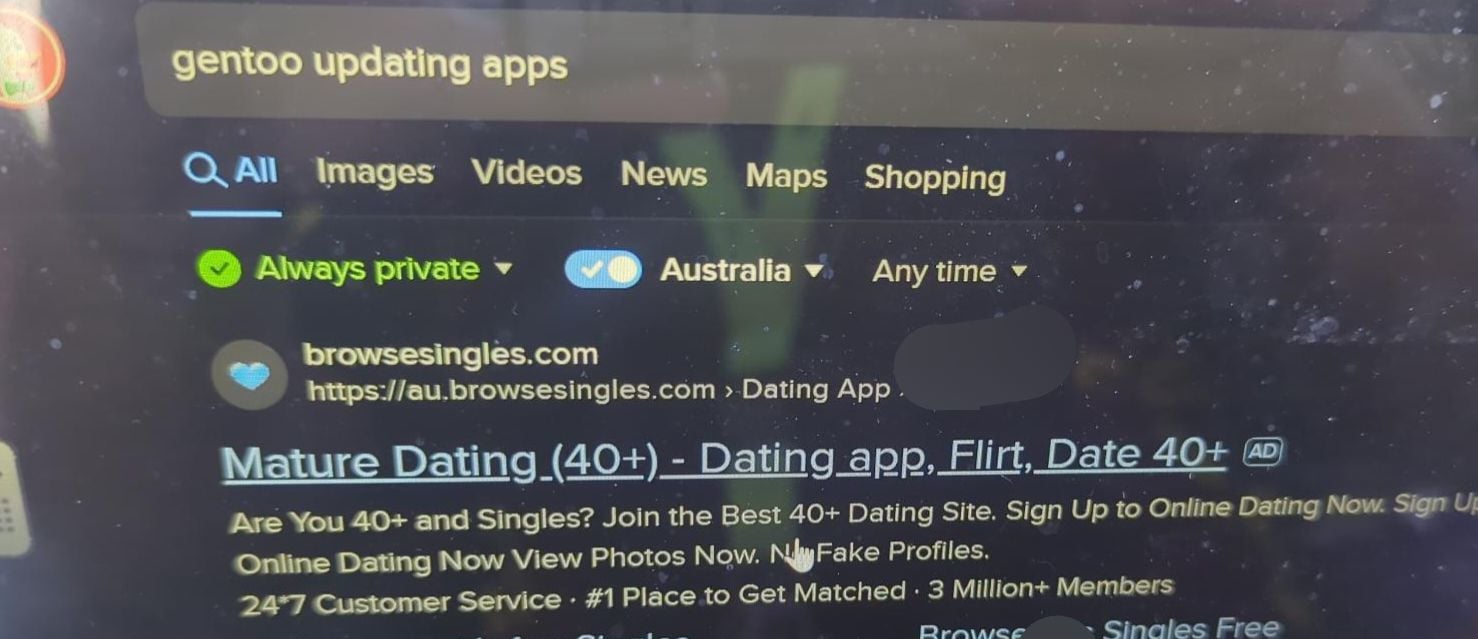
On a more serious note, how does updating apps on gentoo work? I understand that everything is built on your system, but then if the app is updated, do you need to re-compile every time?
On a more serious note, how does updating apps on gentoo work? I understand that everything is built on your system, but then if the app is updated, do you need to re-compile every time?
Yes, you recompile each time you update.
In general, to upgrade an app you do:
root # emaint --auto syncroot # emerge --update $PACKAGE_NAME(That first command used to just be something like
root # emerge --syncwhen I last used Gentoo, two decades ago. I wonder why they changed it?)See also: https://wiki.gentoo.org/wiki/Upgrading_Gentoo
Wouldnt that take a long time every update? Or are all the horror stories of long compile times just a thing of the past with better hardware now?
Well, yeah, but that’s what you sign up for when you choose to use Gentoo. Custom-compiling every app, every time, with your chosen USE flags, is the advantage of it. (I suppose Gentoo has “binary packages” available now, but at that point I don’t see why you wouldn’t just pick Arch instead to begin with.)
Also, that’s another reason you should update frequently (e.g. daily or weekly): to keep compilation times reasonable by only ever updating a few packages at once.
Also also, as I said, I last used Gentoo two decades ago. Even back then, I found the compilation times… uh, at least “tractable.” 😅 I can only assume that with modern hardware they’re not bad at all, as for the most part, processing power has scaled faster than FOSS code complexity.