Image description:
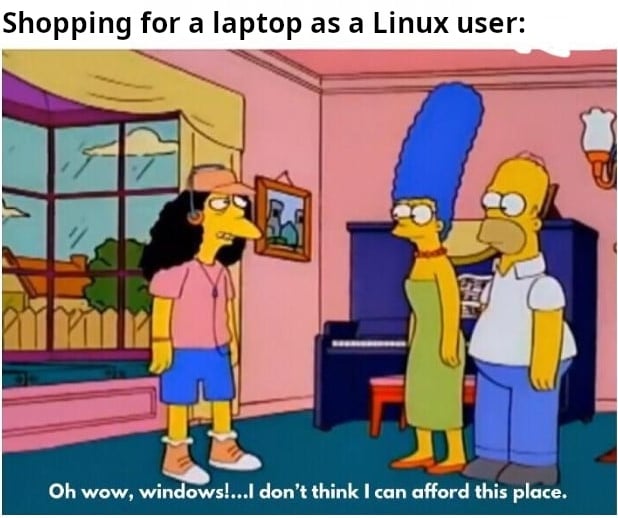
Shopping for a laptop as a Linux user:
Screenshot from the Simpsons where Otto is talking to Marge and Homer standing next to a window in their house with a caption “Oh wow, windows!.. I don’t think I can afford this place.”
The bigger issue for me is every device advertised to be linux based and privacy oriented is >400$ usually around 700-800$
I understand that tech savy IT people are usually financially cushy enough that they can eat a almost thousand dollar bill on their laptop and not think twice about it but man I just can’t ever see myself willing to shell out that much cash for a fancy laptop with physical kill switches or modularbility. Bring that price tag down a couple hundred dollars system 76 and Purism, then well talk. Until then the dude on ebay selling librebooted ghostpads are more likely to get my money.
A lot of the time you aren’t actually paying for the license afaik. If you look at a pre built and spec it out on PC part picker, the pre built can often come at a lower price bc the PC is subsidized with payment from the bloatware that is pre installed (think McAfee). Microsoft also sells the licenses in bulk to the store for huge discounts. Windows business model is a lot more about selling you 365 and your data than the operating system.
Not to be that “aktchually” guy, but Microsoft actually ends up paying OEM’s to ship with Windows, in order to drive costs down to be more affordable than competitors. You can still reimage with Linux, which I know, is an extra step from it shipping with Linux, but in a wild turn of events, we can thank Microsoft for driving down the prices of our to-be-Linux machines ;)
I haven’t met a Linux user that would consider leaving the factory installed OS instead of immediately blowing it out and installing their own
I think that was only true back in the 90s, when there were still other OSes to compete against Windows, like OS/2, Solaris and BeOS late in the decade. Once Microsoft effectively dominated the consumer PC market (2000s?), they turned around to threaten to never do business with OEMs that dared to bundle competitors’ OS. They also did something similar in Japan, which destroyed NEC (who created the PC-88 and PC-98, the most popular 80s and early 90s computers there) dominance.