
You must log in or # to comment.
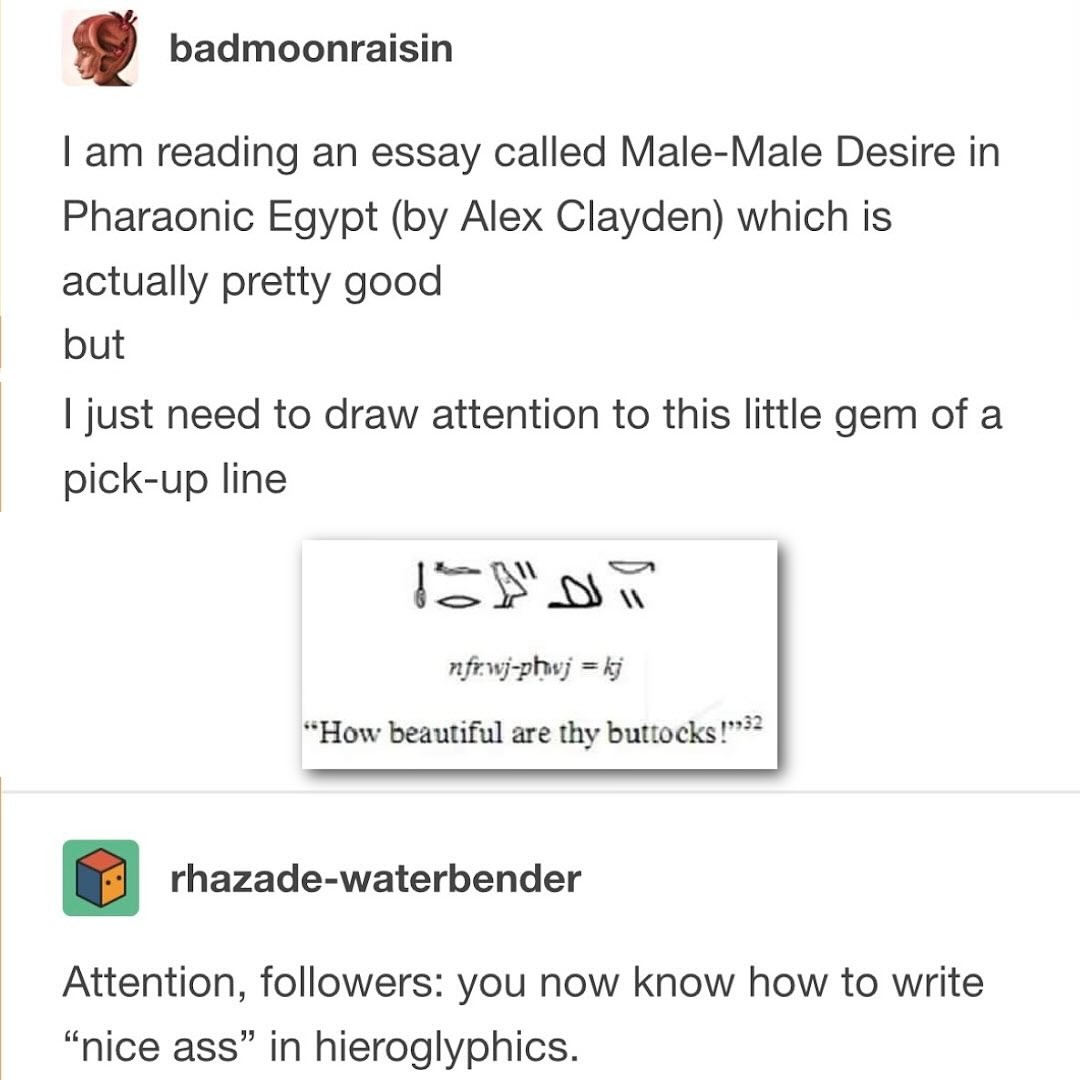
Fun fact. Hieroglyphs can be written left-to-right or right-to-left. You have to distinguish the direction they should be read by the facing of the animal/creature/human used as a character. They will always “look” towards the beginning of the sentence, so in the depicted case, the intended direction is left-to-right.
There are stone carvings in various scripts all the way up to Ancient Greek that are written in an alternating way: first row right to left, then left to right and so on. This style is called boustrophedon.
Were they written in boustrophedon?
According to another comment here, yes. I never heard of that tho, it’s kinda neat.
The paper is supposedly from 2012. Is it like a standard that academic texts translating ancient languages use the oldest possible form of the destination language or do people just do that to denote that the source is old?
I feel like there’s a good argument that the more valid translation is the one that uses modern words and grammar.
There are a variety of reasons to use archaic terms like ‘thy’. One is, legitimately, just stylization, something even academics are not immune to.
However, archaic terms like ‘thy’ are sometimes used in place of politenesses that have no direct English equivalent - some languages have pronouns which are, specifically, respectful or formal (such as the Spanish ‘usted’ - likewise translated by Hemingway, not an academic but a respected writer, in For Whom The Bell Tolls as ‘thee’ and ‘thou’).
I know nothing about Ancient Egyptian, but this could be either.
Vaguely related thought because I was reminded of this earlier: legend has it that German chancellor Helmut Kohl once told a foreign dignitary from an English-speaking country, in English: “You can say you to me.” Which is at least weird in English but the German equivalent is perfectly cromulent because we have two words for “you”: he was trying to signal friendship by offering the more familiar, friendly one.
Absurdly, a “correct” translation for what he was trying to say would’ve been: “Thou canst say thou to me.”
(Worth noting that the story is apocryphal - although there’s a cherished tradition of German politicians failing miserably at English)
(although there’s a cherished tradition of German politicians failing miserably at English)
“Ich bin ein Berliner”
It’s weird how they turned into formal words. Weren’t they familiar forms and “you” was formal?
Modern English translation: … Hey babe, nice ass
Modern Internet slang: … Aww lawd, dem cheeks gonna send a clap of thunder!
You brought cake!
“I’m trying to sneak into the Pyramids, but the clap of my dummy thicc ass cheeks keeps alerting the Pharaoh’s guards!”
I believe this is the Unicode:
𓄤𓆑𓂋𓅱𓏭𓄖𓎡𓏭
Unfortunately the joiners don’t seem to be supported on most devices.